
Table of Contents
The United States, Myanmar, and Liberia. These three countries share something unexpected: they're the only nations that haven't officially adopted the Celsius temperature scale. But how did America end up measuring weather in a system that seems bizarre to the rest of the world? The answer involves German scientists, the British Empire, and a failed 1970s government program that cost millions.
1Daniel Fahrenheit's Clever (But Flawed) System
In 1724, a German physicist named Daniel Fahrenheit created his temperature scale while working in the Netherlands. His goal was practical: he wanted to avoid negative numbers in everyday weather measurements.
The Strange Logic of 0 degrees F and 100 degrees F
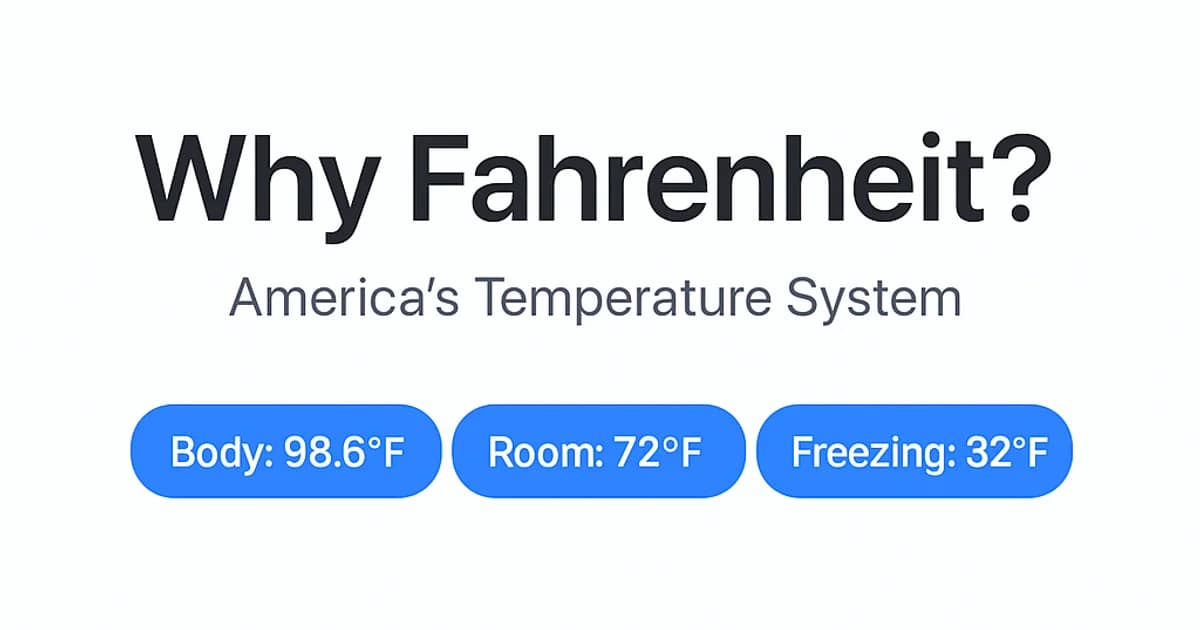
Fahrenheit set 0 degrees at the coldest temperature he could reliably create in his lab (a mixture of ice, water, and ammonium chloride salt). He then set 100 degrees at what he believed was human body temperature. The problem? He measured wrong. Normal body temperature is actually 98.6 degrees F, not 100 degrees F. Despite this error, the scale stuck.
Why 32 degrees F for Freezing?
Water freezes at 32 degrees F because of how Fahrenheit calibrated his scale. It seems arbitrary today, but at the time, it served its purpose: most European winter temperatures stayed above 0 degrees F, avoiding confusing negative numbers in daily life.
2How America Got Fahrenheit
When British colonists arrived in America, they brought Fahrenheit with them. The scale had become standard in Britain and its colonies during the 18th century. After American independence in 1776, the young nation kept using what it knew.
The British Switch (That America Didn't Follow)
Here's the twist: Britain itself switched to Celsius in the 1960s as part of a broader metrication effort. Former British colonies like Canada, Australia, and India followed. But the US, by then fiercely independent, chose not to follow its former colonial power.
The Failed Metric Conversion Act of 1975
President Gerald Ford signed the Metric Conversion Act, creating a board to coordinate America's switch to metric. The problem? It was voluntary. Without mandatory deadlines, industries ignored it. The board was disbanded in 1982, and America stayed imperial.
3The Real Reasons America Won't Switch
Today, switching would be expensive and unpopular. Weather forecasters, thermostats, ovens, and decades of cultural reference points would need to change.
The Cost Argument
Replacing road signs alone would cost hundreds of millions of dollars. Every thermostat, oven, and weather app would need updates. Manufacturing equipment would require recalibration. For a country of 330 million people, the transition costs are staggering.
Cultural Resistance
Americans grow up knowing that 70 degrees F is comfortable, 32 degrees F is freezing, and 100 degrees F is dangerously hot. Telling someone it's 21 degrees C outside doesn't trigger the same intuitive understanding. This cultural muscle memory is hard to unlearn.
The Irony: America Uses Celsius Where It Matters
American scientists exclusively use Celsius (and Kelvin). Hospitals measure body temperature in Celsius. The pharmaceutical industry uses metric. In fields where international collaboration and precision matter, America quietly uses the same system as everyone else.
4Is Fahrenheit Actually Better for Weather?
Some Americans argue that Fahrenheit is actually superior for describing outdoor temperatures. Is there any truth to this?
The 0-100 Weather Range
In much of the US, outdoor temperatures range from 0 degrees F (very cold) to 100 degrees F (very hot). This gives Fahrenheit a neat 0-100 scale for daily weather. In Celsius, the same range is -18 degrees C to 38 degrees C, which some find less intuitive.
More Precision Without Decimals
Fahrenheit degrees are smaller (1 degrees F = 0.56 degrees C), meaning you can describe temperature more precisely without using decimals. The difference between 70 degrees F and 71 degrees F (about 0.5 degrees C) is noticeable, while weather apps rarely show 21.5 degrees C.
The Counter-Argument
Celsius fans point out that 0 degrees C = freezing and 100 degrees C = boiling is far more logical than Fahrenheit's arbitrary reference points. For science, cooking, and international travel, Celsius makes more sense.
Pro Tips
- 1Quick mental conversion: Take Celsius, double it, and add 30 for a rough Fahrenheit estimate
- 2Key temperatures to remember: 0 degrees C = 32 degrees F (freezing), 100 degrees C = 212 degrees F (boiling)
- 3Room temperature: 20-22 degrees C = 68-72 degrees F
- 4Body temperature: 37 degrees C = 98.6 degrees F
America uses Fahrenheit because of historical accident, cultural inertia, and the high cost of change. The 1975 attempt to switch failed because it was voluntary, and no government since has been willing to force the issue. While this creates friction for international travelers and scientists, most Americans simply don't see a compelling reason to change what works for daily life.