
Table of Contents
Have you ever wondered why Americans measure height in feet and inches while most of the world uses centimeters? Or why recipes from the UK might list ingredients in ounces while a French recipe uses grams? The answer lies in the fascinating history of two competing measurement systems: the metric system and the imperial system. Understanding these systems is not just academic - it's important for international travel, cooking, science, and everyday life.
1The Origins of Each System
The imperial system has roots going back thousands of years. Ancient civilizations used body parts as measurements - a 'foot' was literally the length of a human foot, and an 'inch' was the width of a thumb. While practical for everyday use, these measurements varied from person to person and region to region.
The Imperial System's History
The British Imperial System was standardized in 1824, bringing together various local measurements used across the British Empire. Units like miles, yards, feet, and inches for length; pounds and ounces for weight; and gallons and pints for volume became official standards. This system spread throughout British colonies, which is why the United States, having been a British colony, still uses a version of it today.
The Birth of the Metric System
The metric system was created during the French Revolution in the 1790s. Scientists wanted a universal, logical system based on nature. They defined the meter as one ten-millionth of the distance from the equator to the North Pole. Everything in the metric system is based on powers of ten, making calculations straightforward: 1 kilometer = 1,000 meters = 100,000 centimeters.
2Key Differences Between the Systems
The importante difference is simplicity. The metric system uses base-10 prefixes (kilo-, centi-, milli-) consistently across all measurements. Converting 5 kilometers to meters? Multiply by 1,000. Converting 5 miles to feet? You need to multiply by 5,280 - not as intuitive.
Length Measurements
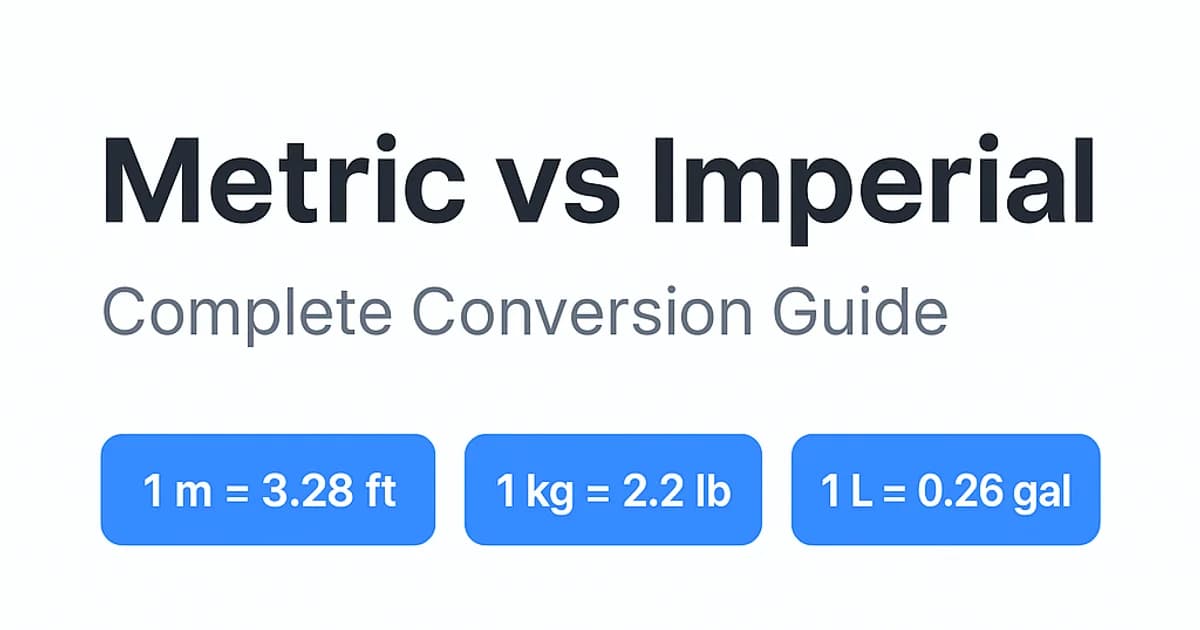
Metric uses millimeters, centimeters, meters, and kilometers with consistent conversions (1m = 100cm = 1000mm). Imperial uses inches, feet, yards, and miles with irregular conversions (1 foot = 12 inches, 1 yard = 3 feet, 1 mile = 1,760 yards). For reference: 1 inch = 2.54 cm, 1 foot = 30.48 cm, and 1 mile = 1.609 km.
Weight Measurements
Metric weight is based on the gram: 1 kilogram = 1,000 grams. Imperial uses ounces, pounds, and stones. The conversions are irregular: 1 pound = 16 ounces, 1 stone = 14 pounds. Key conversions: 1 kg = 2.205 pounds, 1 ounce = 28.35 grams.
Volume Measurements
Metric uses liters and milliliters (1L = 1,000mL). Imperial has two versions: US and UK. A US gallon is 3.785 liters, while a UK gallon is 4.546 liters. This difference causes confusion in recipes and fuel economy comparisons.
3Which Countries Use Which System?
Today, only three countries have not officially adopted the metric system: the United States, Myanmar, and Liberia. However, the US uses metric in scientific contexts, medicine, and the military. The UK uses a mix - road signs show miles, but most products use metric measurements. This hybrid approach causes daily confusion for residents and visitors alike.
Why the US Hasn't Switched
The US attempted to switch to metric in the 1970s with the Metric Conversion Act, but it was voluntary and ultimately failed. The cost of replacing road signs, manufacturing equipment, and retraining workers was deemed too high. Today, American manufacturers often produce products with both measurement systems to serve global markets.
4Common Conversion Mistakes to Avoid
When converting between systems, precision matters. A small error can become significant at scale. Here are the most common mistakes people make:
The Mars Climate Orbiter Disaster
In 1999, NASA's $125 million Mars Climate Orbiter was lost because one engineering team used metric units while another used imperial. The spacecraft entered Mars' atmosphere at the wrong angle and was destroyed. This disaster highlights why consistent units are critical in engineering and science.
Kitchen Measurement Confusion
A US cup is 236.6 mL, while a UK cup is 284 mL. Using the wrong cup measurement in baking can ruin recipes. Fluid ounces are also different: a US fluid ounce is 29.57 mL, while a UK fluid ounce is 28.41 mL.
Pro Tips
- 1Remember key conversions: 1 inch = 2.54 cm, 1 kg = 2.2 lbs, 1 mile = 1.6 km
- 2For rough estimates: double the kilometers and add 10% to get miles
- 3When cooking, use a digital scale for accuracy rather than volume measurements
- 4Check if a recipe is using US or UK measurements before starting
Understanding both measurement systems is increasingly important in our globalized world. Whether you're following an international recipe, shopping online from foreign retailers, or working in science and engineering, being comfortable with both metric and imperial units is a valuable skill. The good news is that conversion is now easier than ever with digital tools. Our converters let you instantly switch between any units, eliminating guesswork and preventing costly errors.