
Table of Contents
You're driving a rental car in Germany, and the speedometer shows 120. But wait - is that km/h or mph? Getting this wrong could mean a speeding ticket, or worse, a dangerous situation. Every year, thousands of travelers face this confusion when driving abroad. The difference between kilometers per hour and miles per hour isn't just a number - it's nearly double. Understanding speed limits across different countries can save you money, keep you safe, and make your road trip stress-free.
1Why Speed Units Differ Worldwide
The world is split almost evenly: about 81% of countries use kilometers per hour (km/h), while the US, UK, and a few others use miles per hour (mph). This division dates back to when the British Empire spread the mile across its colonies, while continental Europe adopted the metric system after the French Revolution.
Countries Using mph
Only a handful of countries display speed limits in miles per hour: the United States, United Kingdom, Antigua and Barbuda, the Bahamas, Dominica, Grenada, Saint Lucia, and Saint Vincent. If you're not in one of these countries, assume speed signs are in km/h.
The UK's Confusing Mix
The UK is unique: road signs show miles, but most other measurements use metric. Cars sold in the UK have speedometers showing both mph and km/h. This creates confusion for tourists driving rental cars with European speedometers that emphasize km/h.
2Speed Limits by Region: A Practical Guide
Speed limits vary significantly by country and road type. Here's what you need to know for the most common driving destinations:
Western Europe
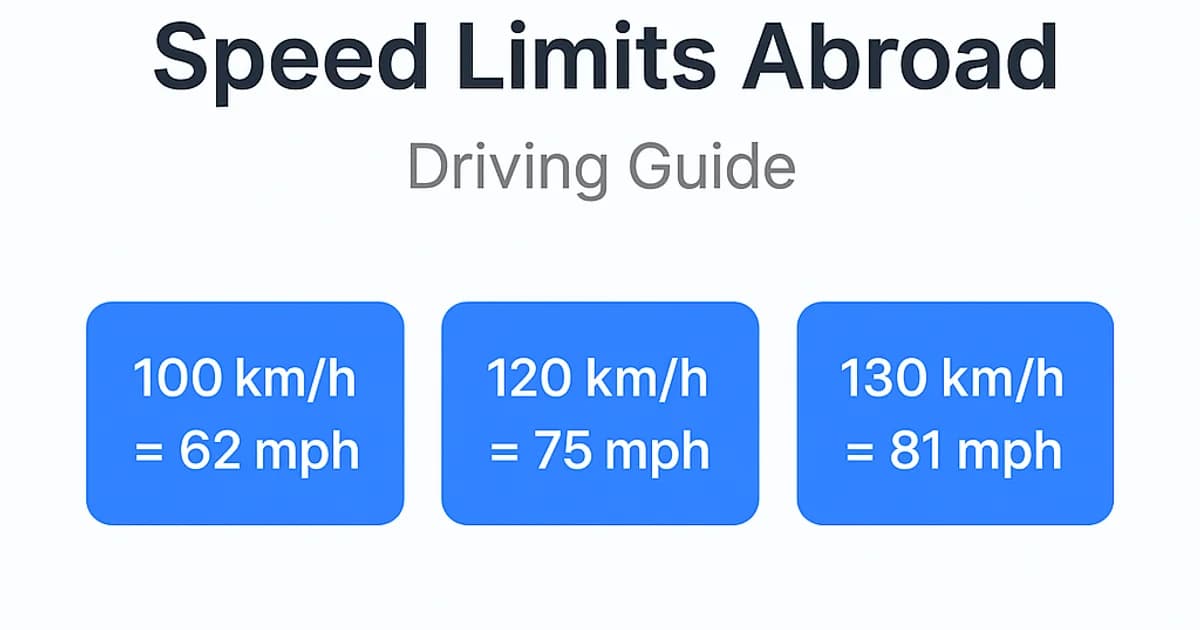
Most Western European countries follow similar patterns: - Urban areas: 50 km/h (31 mph) - Rural roads: 80-90 km/h (50-56 mph) - Highways: 110-130 km/h (68-81 mph) Germany's famous Autobahn has sections with no speed limit (marked by a white circle with diagonal lines). However, many stretches do have limits, so watch the signs carefully.
United States
US highway speed limits vary by state: - Texas: Up to 85 mph (137 km/h) on some toll roads - California: 65-70 mph (105-113 km/h) on highways - Montana: 80 mph (129 km/h) on rural interstates Urban areas typically range from 25-35 mph (40-56 km/h). School zones can be as low as 15 mph (24 km/h).
Australia and New Zealand
Both countries use km/h: - Australia: 100-110 km/h (62-68 mph) on highways, with some Northern Territory stretches at 130 km/h - New Zealand: 100 km/h (62 mph) maximum on open roads, 50 km/h in urban areas
3Quick Conversion Methods
When you're behind the wheel, you need fast mental math. Here are reliable shortcuts that work without a calculator:
The Multiply-by-0.6 Rule for km/h to mph
To convert km/h to mph quickly: multiply by 0.6 (or divide by 1.6). - 100 km/h x 0.6 = 60 mph - 120 km/h x 0.6 = 72 mph - 80 km/h x 0.6 = 48 mph This gives you a result within 1-2 mph of the exact conversion.
The Multiply-by-1.6 Rule for mph to km/h
Going the other way: multiply by 1.6. - 60 mph x 1.6 = 96 km/h - 70 mph x 1.6 = 112 km/h - 30 mph x 1.6 = 48 km/h Remember: km/h numbers are always larger than mph for the same speed.
4Reading a Foreign Speedometer
Rental cars can have speedometers configured for different markets. Here's how to avoid confusion:
Dual-Scale Speedometers
Many modern cars show both units. The larger numbers on the outer ring are usually the primary unit for that market. In Europe, km/h appears in large text; mph appears in small text. In the US and UK, it's reversed.
Digital Displays
Most digital dashboards let you switch between km/h and mph through the settings menu. Before leaving the rental lot, ask the staff to set it to your preferred unit, or check the owner's manual.
GPS Navigation Apps
Google Maps and other navigation apps show your current speed and local limits. This is a reliable backup when your speedometer is confusing. Just make sure to set the app to display the local unit (km/h in Europe, mph in US/UK).
Pro Tips
- 1Photograph speed limit signs when entering a new country as a reference
- 2Remember: 100 km/h = 60 mph, 130 km/h = 80 mph (close enough for safety)
- 3Set your phone's GPS to display speed in the local unit before driving
- 4In Europe, built-up area signs (white with red border) mean 50 km/h limit starts
Driving abroad doesn't have to be stressful. The key is preparation: know whether your destination uses km/h or mph, memorize the 0.6 multiplication trick, and double-check your speedometer before hitting the road. Speed limit signs are universal in shape - they're always circular with a number - so even if you can't read the language, you'll know what to look for. With our speed converter, you can also prepare a quick reference list for common limits before your trip.