
Table of Contents
You packed your item carefully, weighed it on your bathroom scale, and headed to the shipping counter confident in your estimate. Then the clerk hit you with a bill twice what you expected. What happened? The package only weighed 5 pounds. Here's what caught you off guard: carriers don't just charge by actual weight anymore. They use something called dimensional weight - a formula that calculates what your package "should" weigh based on its size. A large, lightweight box costs the same to ship as a small, heavy one because it takes up the same truck space. Understanding this system can save you hundreds of dollars a year if you ship regularly.
1The Dimensional Weight Formula Everyone Gets Wrong
Dimensional weight sounds complicated, but the math is straightforward once you know the formula. The problem is that different carriers use different divisors, and most people don't realize this until they're standing at the counter.
The Standard Formula: L x W x H / 166
For domestic US shipments, UPS and FedEx both use 166 as their divisor when measuring in inches. Multiply length x width x height, then divide by 166. A box measuring 20" x 15" x 12" equals 3,600 cubic inches. Divide by 166, and you get 21.7 pounds of dimensional weight. If your actual item weighs only 8 pounds, you'll be charged for 22 pounds.
International Shipping Uses a Different Divisor
For international shipments, the divisor drops to 139 (or even 166 for some carriers). This means the same 20" x 15" x 12" box would have a dimensional weight of 25.9 pounds internationally. And if you're measuring in centimeters, the formula changes to L x W x H / 5000 (in cm) for most international carriers. A 50cm x 38cm x 30cm box gives you 57,000 / 5000 = 11.4 kg dimensional weight.
Billable Weight: The Higher Number Wins
Carriers compare your actual weight to dimensional weight and charge you for whichever is higher. They call this the "billable weight." This is why packing efficiently matters so much. A pillow in an oversized box costs far more than the same pillow vacuum-sealed into a smaller package.
2Weight Limits by Carrier: The Complete Breakdown
Each major carrier has different maximum weight limits, and these vary by service level. Knowing the limits before you pack can save you from splitting shipments or choosing the wrong carrier.
UPS Weight Limits
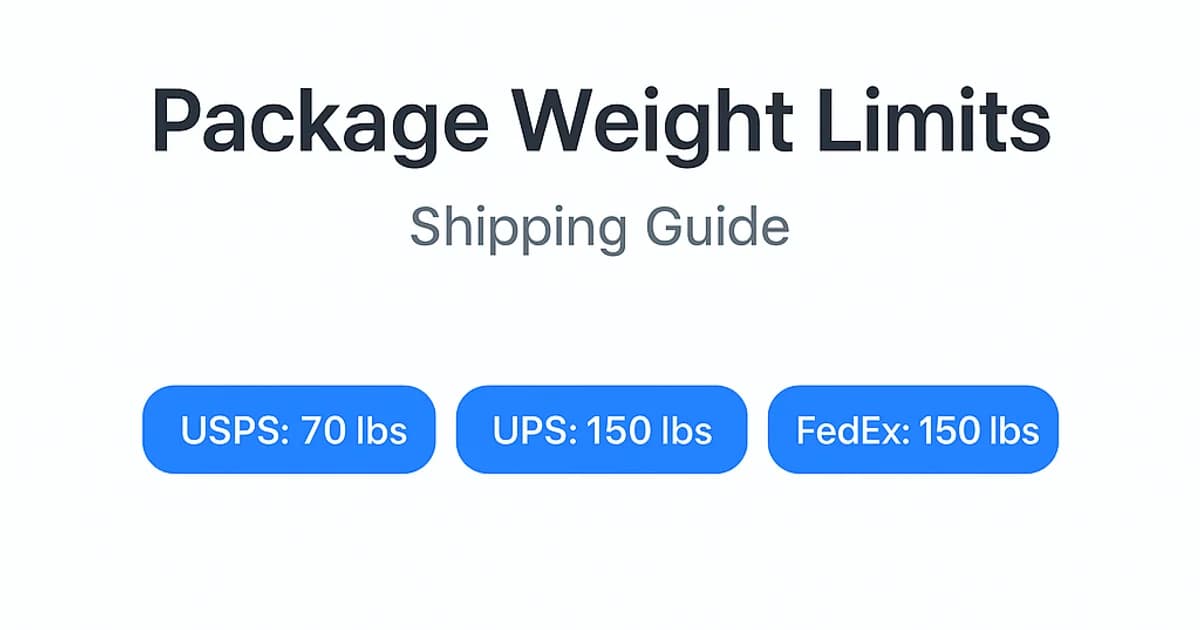
UPS Ground and UPS Air services accept packages up to 150 lbs (68 kg) with a maximum combined length + girth of 165 inches (419 cm). For UPS Freight (LTL), the limit jumps to 20,000 lbs per shipment. UPS also has size limits: no single package dimension can exceed 108 inches (274 cm). If your package is over 70 lbs, UPS requires a "heavy package" label.
FedEx Weight Limits
FedEx Ground and Express services match UPS at 150 lbs (68 kg) per package. The combined length + girth limit is also 165 inches. FedEx Freight handles shipments up to 20,000 lbs. One difference: FedEx One Rate boxes have their own weight limits - the large box maxes out at 50 lbs, while the extra-large tops at 50 lbs too. Going over means you lose the flat-rate pricing.
DHL Express Limits
DHL Express accepts packages up to 154 lbs (70 kg) per piece, slightly higher than UPS and FedEx. The maximum dimensions are 120 inches (300 cm) for the longest side. For multi-piece shipments, there's no total weight limit, but each individual piece must stay under 154 lbs. DHL uses a dimensional weight divisor of 139 for international and 166 for domestic US shipments.
USPS Weight Limits
USPS has the most restrictive weight limits: 70 lbs (31.75 kg) maximum for all domestic services. Priority Mail, First-Class, and Media Mail all share this cap. The combined length + girth can't exceed 130 inches (330 cm). For flat-rate boxes, weight doesn't matter for pricing - but you still can't exceed 70 lbs. International USPS shipments have country-specific limits, ranging from 22 lbs to 70 lbs depending on destination.
3International Shipping: Rules That Trip People Up
Shipping across borders adds layers of complexity. Weight limits change, dimensional weight calculations shift, and customs regulations come into play.
Metric vs Imperial: Know Your Numbers
Most countries outside the US use kilograms and centimeters. A 70 lb limit becomes 31.75 kg. A 150 lb limit is 68 kg. When calculating dimensional weight internationally, you'll use the formula L x W x H (in cm) / 5000 for most carriers. Getting this wrong means either overpaying or having your shipment rejected at the origin facility.
Country-Specific Weight Restrictions
Some countries impose their own weight limits regardless of carrier. Germany restricts certain import packages to 31.5 kg. Japan has different limits for commercial vs personal shipments. Australia requires special handling for anything over 22 kg. Always check destination country regulations before shipping - carrier websites have country-specific guides.
Customs and Declared Weight
The weight you declare on customs forms must match actual weight. Underreporting to save on duties can result in fines, delays, or seized shipments. Customs authorities in the EU, UK, and Canada routinely weigh incoming packages. If there's a significant discrepancy, your recipient pays the difference plus penalties.
4Money-Saving Strategies for Regular Shippers
Now that you understand the rules, here's how to work within them to minimize costs. Professional shippers use these techniques daily.
Right-Size Your Packaging
The biggest waste in shipping is air. Using a 20" x 20" x 20" box for an item that fits in 12" x 8" x 6" costs you 4-5 times more in dimensional weight. Invest in a variety of box sizes. For oddly shaped items, custom-cut boxes beat oversized standard ones. Some businesses save 30-40% just by auditing their box inventory.
Compare Carriers for Each Shipment
UPS might be cheaper for heavy, compact items. USPS flat-rate often wins for dense products under 70 lbs. FedEx SmartPost can beat ground rates for lightweight items. DHL frequently offers better international rates. Use multi-carrier shipping software to compare real-time rates before each shipment.
Negotiate Volume Discounts
If you ship more than 50 packages per month, you qualify for negotiated rates with most carriers. UPS and FedEx will assign account representatives who can discount dimensional weight divisors, reduce surcharges, and waive certain fees. Even small businesses can get 20-40% off published rates by simply asking.
Pro Tips
- 1Memorize the US domestic formula: L x W x H / 166 (in inches) = dimensional weight in pounds
- 2International metric formula: L x W x H / 5000 (in cm) = dimensional weight in kilograms
- 3USPS flat-rate boxes ignore dimensional weight - pack them full for maximum value
- 4Always round up: carriers round dimensional weight to the next whole pound or kilogram
- 5Keep packages under 70 lbs if you want all carrier options including USPS
The shipping industry runs on dimensional weight, and carriers won't tell you how much you could save by packing smarter. A few minutes with a tape measure and calculator before each shipment prevents surprise charges. For regular shippers, understanding these formulas and limits isn't just helpful - it's the difference between competitive pricing and bleeding money on logistics. Use our kilogram to pound and centimeter to inch converters to quickly translate between measurement systems when comparing international carrier options.