
Table of Contents
30 mpg sounds good until you realize Europeans measure fuel economy backwards. Or do they? When Americans talk about great gas mileage, higher numbers are better. But when a German brags about their car's fuel efficiency, they want the lowest number possible. This isn't just a different unit - it's a completely inverted way of thinking about fuel consumption. One system measures how far you can go on a fixed amount of fuel (miles per gallon). The other measures how much fuel you need to travel a fixed distance (liters per 100 kilometers). Understanding both systems matters when you're comparing cars from different markets, reading international reviews, or shopping for a vehicle abroad.
1The importante Difference: Distance vs Consumption
Here's what trips up most people: mpg and L/100km don't just use different units - they measure fuel economy from opposite directions. With mpg, you're asking 'How far can I go with one gallon?' Higher is better. With L/100km, you're asking 'How many liters do I need to travel 100 km?' Lower is better. This creates a non-linear relationship that makes mental conversion tricky.
Why Americans Chose Miles Per Gallon
The mpg system became standard in the US during the early automobile era. It made sense for long road trips: 'I have a tank of gas, how far will it take me?' Americans were thinking in terms of range and freedom. The bigger the number, the further you could travel, the more American Dream you could achieve. When the 1970s oil crisis hit, mpg became the shorthand for automotive virtue.
Why Europe Chose L/100km
European engineers took a different approach. They asked: 'For a standard journey of 100 kilometers, what's the cost?' This consumption-based metric connects directly to real spending. If fuel costs 1.50 euros per liter and your car uses 6 L/100km, you know exactly what 100 km will cost: 9 euros. The math is simpler for budgeting, which matters when fuel taxes make gas three times more expensive than in the US.
The Non-Linear Problem
Here's where it gets counterintuitive. Improving from 10 mpg to 20 mpg saves way more fuel than improving from 30 mpg to 40 mpg. In L/100km, this is obvious: going from 23.5 to 11.7 L/100km is a huge drop, while going from 7.8 to 5.9 L/100km is much smaller. The European system makes efficiency gains easier to compare because it's linear with actual fuel saved.
2The Magic Formula: 235 Divided by MPG
Ready for the shortcut that makes international car shopping possible? To convert mpg to L/100km, divide 235 by your mpg number. To go the other way, divide 235 by your L/100km number. Why 235? It's the mathematical constant that bridges gallons, liters, miles, and kilometers.
How the Math Works
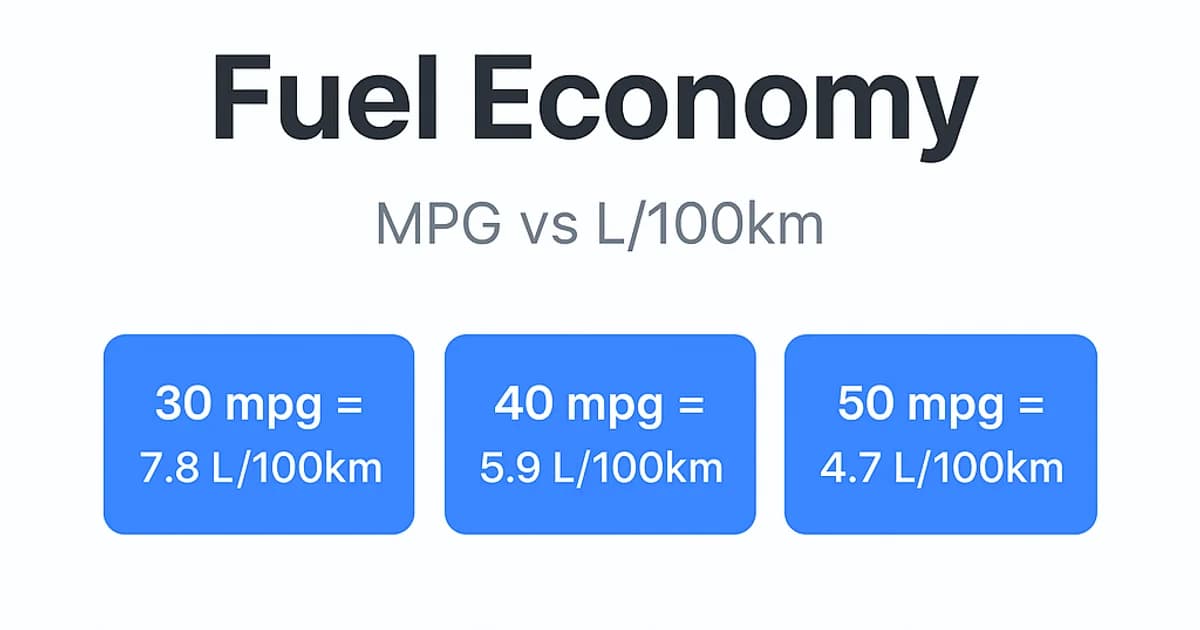
The full formula is: L/100km = 378.541 / (mpg x 1.60934). But 378.541 divided by 1.60934 equals roughly 235.2. So we round to 235 for easy mental math. For US gallons (not UK imperial gallons), this works perfectly: - 30 mpg = 235/30 = 7.8 L/100km - 40 mpg = 235/40 = 5.9 L/100km - 50 mpg = 235/50 = 4.7 L/100km
Common Conversions to Memorize
Here are the numbers that come up most in car shopping: - 20 mpg = 11.8 L/100km (typical large SUV) - 25 mpg = 9.4 L/100km (midsize sedan, combined) - 30 mpg = 7.8 L/100km (compact car, highway) - 35 mpg = 6.7 L/100km (efficient compact) - 40 mpg = 5.9 L/100km (hybrid territory) - 50 mpg = 4.7 L/100km (efficient hybrid) - 60 mpg = 3.9 L/100km (plug-in hybrid, some use)
Watch Out for UK Imperial MPG
British fuel economy uses imperial gallons, which are 20% larger than US gallons. A UK car rated at 50 mpg (imperial) is actually about 42 mpg (US). When converting UK specs to L/100km, use 282 instead of 235. This catches many buyers off guard when importing vehicles or reading UK car reviews.
3Real-World Applications
Knowing these conversions matters in surprisingly practical situations. Whether you're reading international car reviews, comparing a European import to local models, or renting a car abroad, the mpg-to-L/100km translation helps you make informed decisions.
Comparing International Car Reviews
A British magazine praises a car for achieving 45 mpg (imperial). A German site rates the same car at 6.3 L/100km. An American reviewer says 37 mpg. Are these contradicting each other? Actually, they're all saying roughly the same thing - you just need the conversion. 45 UK mpg = 282/45 = 6.3 L/100km = 235/6.3 = 37 US mpg.
Renting Cars in Europe
European rental cars display L/100km on the dashboard. If you're used to mpg, a reading of '8.5' might seem meaningless. Now you know: 235/8.5 = about 28 mpg. You're doing fine. If the display shows '12', you might want to ease off the accelerator - that's barely 20 mpg.
Shopping for Imports
Japanese domestic market cars often use km/L (kilometers per liter), not L/100km. That's another inversion: higher km/L is better. To convert: 100 divided by km/L gives you L/100km. A car rated at 20 km/L = 5 L/100km = about 47 mpg. Gray market imports from Japan can offer excellent efficiency if you know how to read the specs.
4Why the Difference Actually Matters
Beyond unit conversion, the mpg vs L/100km debate reveals something deeper about how we think about efficiency. The choice of measurement system affects consumer behavior and even government policy.
The MPG Illusion
Research shows that Americans systematically underestimate fuel savings when using mpg. Asked which saves more fuel - upgrading from 10 to 20 mpg, or from 30 to 40 mpg - most people say it's equal or that 30-to-40 is better. In reality, going from 10 to 20 mpg (cutting consumption from 23.5 to 11.8 L/100km) saves 11.7 liters per 100 km. Going from 30 to 40 mpg (7.8 to 5.9 L/100km) saves only 1.9 liters. The mpg scale hides this.
Policy Implications
Fuel consumption in L/100km and CO₂ emissions in g CO₂/km are different quantities. The EEA passenger-car indicator describes the fleet CO₂ targets under Regulation (EU) 2019/631 in g CO₂/km. A consumption figure alone does not specify emissions without fuel and accounting assumptions. This example identifies the metric; it is not a summary of all current legal requirements. [2]
Electric Vehicles Change Everything
Electric cars throw another variable into the mix. The US uses MPGe (miles per gallon equivalent), where 33.7 kWh equals one gallon of gas. Europe uses kWh/100km. A Tesla Model 3 might rate 134 MPGe in the US and 14.3 kWh/100km in Europe. The inverse relationship continues: for EVs, higher MPGe and lower kWh/100km both mean better efficiency.
Pro Tips
- 1Quick conversion: 235 divided by mpg equals L/100km (and vice versa)
- 2Lower L/100km is better; higher mpg is better - they work in opposite directions
- 3For UK imperial mpg, use 282 instead of 235 in the conversion formula
- 4A car using 8 L/100km costs about 12 euros per 100 km at European pump prices
- 5When renting in Europe, dashboard readings of 6-8 L/100km indicate good efficiency
The mpg vs L/100km divide isn't just about numbers - it's about two different ways of thinking about fuel economy. Americans ask how far their fuel will take them; Europeans ask how much fuel their journey will cost. Neither is wrong, but knowing how to translate between them opens up the global car market. Remember the magic number: 235. Divide it by mpg to get L/100km, or divide by L/100km to get mpg. With this simple formula, you can compare any vehicle from any market and make smarter choices whether you're buying, renting, or just reading reviews.