
Table of Contents
You step on the gym scale: 82 kg. Great. Now you open your fitness app to log it, and it asks for pounds. You do the math in your head... or do you? Most people get this wrong, and that small error compounds over weeks of tracking. Here is the thing: if your weight loss app shows you lost 5 lbs but you only dropped 1.8 kg, you did not actually lose more weight in America. It is the same amount - roughly the weight of two basketballs. Understanding these conversions matters because fitness is global, but measurement systems are not.
1The Quick Math That Actually Works
The exact conversion is 1 kg = 2.20462 lbs. But nobody can do that in their head at the gym. Here are tricks that fitness professionals actually use.
The Double-and-Add Method
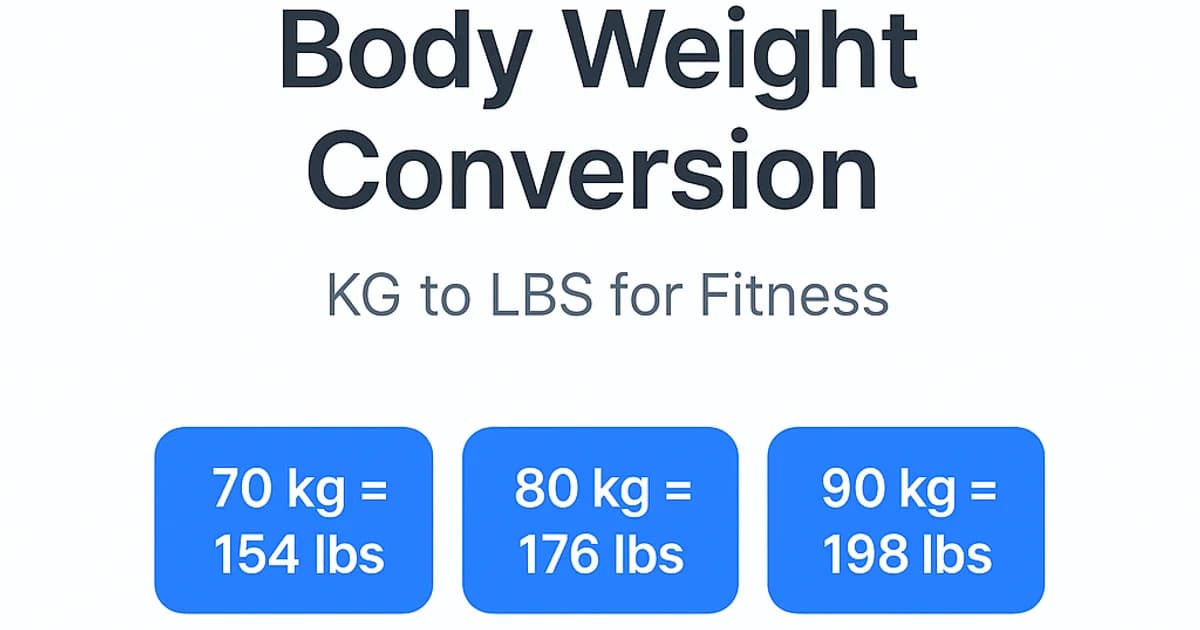
Double your kg weight and add 10%. For 80 kg: 80 x 2 = 160, then add 16 (10% of 160) = 176 lbs. The actual answer is 176.37 lbs. Close enough for tracking purposes. This works because 2.2 is almost exactly 2 + 10% of 2.
Going the Other Way: lbs to kg
Divide by 2.2, or for a quicker estimate, just halve it and subtract 10%. For 180 lbs: half is 90, minus 9 (10%) = 81 kg. Actual answer: 81.6 kg. Again, good enough for daily tracking and workout planning.
The Stone Complication
If you are from the UK or Ireland, you might think in stone (14 lbs per stone). A 12-stone person weighs 168 lbs or 76.2 kg. Many UK gyms still have scales that display stone, which adds another conversion layer.
2Gym Plate Weights: The Complete Reference
Walk into any gym and you will find two different weight systems. Olympic gyms worldwide use kg plates. Most American commercial gyms use lb plates. Knowing both saves you from doing math mid-workout.
Standard Olympic Plates (Metric)
Red: 25 kg (55.1 lbs) | Blue: 20 kg (44.1 lbs) | Yellow: 15 kg (33.1 lbs) | Green: 10 kg (22 lbs) | White: 5 kg (11 lbs) | Red small: 2.5 kg (5.5 lbs) | Blue small: 2 kg (4.4 lbs) | Yellow small: 1.5 kg (3.3 lbs) | Green small: 1 kg (2.2 lbs) | White small: 0.5 kg (1.1 lbs). The Olympic barbell itself weighs exactly 20 kg (44.1 lbs).
American Standard Plates (Imperial)
Common plate sizes: 45 lbs (20.4 kg) | 35 lbs (15.9 kg) | 25 lbs (11.3 kg) | 10 lbs (4.5 kg) | 5 lbs (2.3 kg) | 2.5 lbs (1.1 kg). The standard American barbell weighs 45 lbs (20.4 kg) - slightly heavier than the Olympic bar.
Why the Slight Difference Matters
A 45 lb plate is not exactly 20 kg (it is 20.4 kg). This means loading "135 lbs" (bar + two 45s) is actually 61.2 kg, not 60 kg. For serious lifters tracking progressive overload, this 2% difference compounds. If you bench 135 lbs in the US and travel to a kg gym, load 60 kg - not 62.5 kg.
3BMI Calculation: The kg Advantage
Body Mass Index is calculated as weight divided by height squared. But the formula changes depending on your units, and doctors have a strong preference for one system.
The Metric Formula (Simpler)
BMI = weight (kg) / height (m)^2. For someone 80 kg and 1.80 m tall: 80 / 3.24 = 24.7 BMI. Clean and simple. This is why every hospital and research study in the world uses metric measurements.
The Imperial Formula (Messier)
BMI = weight (lbs) / height (in)^2 x 703. Same person at 176 lbs and 70.9 inches: 176 / 5027 x 703 = 24.6 BMI. You get the same answer, but you need that 703 conversion factor, which introduces rounding errors. Many online calculators get this slightly wrong.
Why Doctors Prefer Kilograms
Medication dosages are calculated in mg per kg. A doctor prescribing 5 mg/kg of a drug for a 75 kg patient knows immediately: 375 mg. With pounds, they would need to convert first - an extra step where errors can happen. In medical contexts, kg is not just preferred; it is the standard.
4Tracking Weight Loss Across Systems
Fitness apps, smart scales, and gym equipment come from different countries with different defaults. Here is how to keep your tracking consistent without going crazy.
Pick One System and Stick With It
The number one mistake people make: switching between kg and lbs randomly. Your brain starts to lose track of actual progress. Pick the system your primary scale uses and convert everything else to match. Most nutrition apps let you change the default unit in settings.
Weekly vs Daily Fluctuations
Body weight fluctuates 1-2 kg (2-4 lbs) daily from water, food, and salt intake. A 0.5 kg difference could be real fat loss or just dehydration. This is why fitness coaches recommend weekly averages rather than daily weigh-ins - the unit system matters less than the trend.
The Goal Setting Trap
"Lose 10 lbs" sounds more impressive than "lose 4.5 kg" but it is the exact same goal. Some fitness marketers exploit this by advertising dramatic-sounding lb numbers. A 30 lb transformation is 13.6 kg - still impressive, but the framing matters for setting realistic expectations.
Pro Tips
- 1Double your kg and add 10% for a quick lbs estimate (80 kg = 160 + 16 = 176 lbs)
- 2An Olympic barbell is exactly 20 kg; an American bar is 45 lbs (20.4 kg)
- 3The 25 kg red plate equals 55.1 lbs; the 45 lb plate equals 20.4 kg
- 4For BMI calculation, stick to metric (kg and meters) to avoid conversion errors
- 5Pick one unit system for all your fitness tracking to see clear progress trends
Whether your gym displays kilograms or pounds, what matters is consistency in tracking and understanding what the numbers actually mean. The fitness industry is global, but measurement systems remain stubbornly local. Now you know how to convert between them without pulling out a calculator every time. For quick mental math: double kg and add 10% to get lbs. For precise conversions, use our kilogram-to-pound converter and track your progress with confidence.